Friday, February 13, 2015

INSPIRATIONAL STORY OF THE DAY: IT'S FASHION WEEK IN NEW YORK CITY

And a model with physical and facial differences--she has Down's Syndrome--is on the runway.  Good for her!  And let her remind us all in this community that we can achieve, too, just like she has.  Read more about it:

*******************************

View image on Twitter

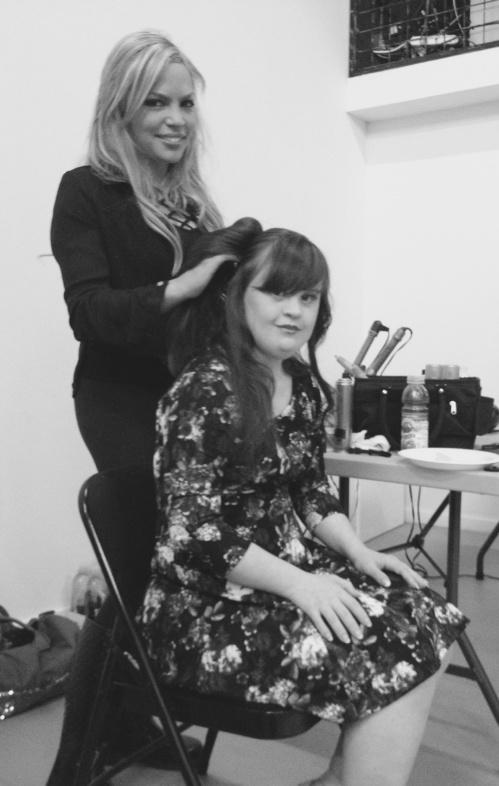
Backstage at New York Fashion Week 2015, actress Jamie Brewer was tweeting pictures of herself as she was getting primped and primed for her runway debut.
“Make-Up Time,” she tweeted. Then “Hair Time Now.”
The pictures showed a young woman with a sweet, round face and big eyes, known for her role in “American Horror Story.”
“Embrace the fear and go for it,” Brewer said. “That’s what I do. I don’t run from it, I embrace the fear.”
On TV, Brewer said she had conquered many fears, including “a drowning scene, attack of zombies, getting hit by a car ... in the first season, being dead and being dragged.”
But Thursday she was doing something she never thought she’d do. She was about to make history as the first model with Down Syndrome to walk the Fashion Week runway.
From Activist to Actress
Brewer was one of a dozen women carefully selected by designer Carrie Hammer to shatter model stereotypes. Billed as “Role Models Not Runway Models,” the show featured CEOs and marketing executives, philanthropists and bankers, computer coders and even a senior vice president whose job title at an ad agency was “Global Chief Creativity Catalyst.”
But of all the women at the top of their game, the star was Jamie Brewer.
“Jamie is an incredible actress and also an activist, an artist and a writer who just happens to have Down syndrome ... but that doesn’t define her,” Hammer said. “She’s an incredible role model for many, many people.”
In addition to being a successful actress, Hammer is also an advocate for people with intellectual disabilities. At 19 she was elected to the State of Texas ARC Board, and she also worked with the Governmental Affairs Committee for the State of Texas, as the only member with a disability.
”I’m a huge advocate for individuals with disabilities,” Brewer said. “Changing the minds of individuals [so they] get a better understanding of individuals that do have disabilities.” “If you work at it, you can achieve it”
The activist turned actress prepared Thursday for her turn as a fashion model. “If you work at it, you can achieve it,” she said simply.
“We’re all really, really excited,” said designer Carrie Hammer. “I’m not nervous at all ‘cause everyone’s awesome.”
As the music swelled the models walked the catwalk one by one, posing at the end for pictures, then walking back. Poised and confident – some slightly nervous - they were dressed in stylish, classy clothes designed specifically for them.
The last to walk was Brewer. Wearing a black, V-neck dress cinched at the waist inspired by “American Horror Story,” she bounded onto the stage with a big smile and unbridled energy. In a blur of perpetual motion, she twirled, pointed her finger at the audience, shimmied and shook - all signature dance moves she said she created in honor of her costars.
At the end of the runway, Brewer raised her hands in the air and with a triumphant fist-pump, strode off the stage. The audience members cheered, some with tears in their eyes.
“Put Your heart and soul into it”
“Jamie really shows everyone that you can become what you imagine,” Hammer told ABC News. “I hope that, watching her, young women know they can become anything, do anything. Your circumstances don’t define you.”
“Take the risk. Take the chance. Put your heart and soul into it, because when you put your soul into it, you will become what you’ve always dreamed,” Brewer said. “You, yourself, will become a legend.”
 
************************************

Thursday, February 12, 2015

MOEBIUS SYNDROME IN THE NEWS: MEET A MOEBIUS ARTIST

Her name is Tracy Harper, and she is from Canada.  How does she express herself?  Through her art, and it is fantastic.  Meet yet another Moebius heroine:

*********************************************

She may not be able to physically smile, but anyone who knows Tracy Harper knows her personality lights up a room and fills others with the warmth of a thousand smiles.
Harper, who suffers from Moebius syndrome, recently beat out 90 other artists to capture the Rare Artist award for her self-portrait titled: What Are You Looking At?
On Thursday, she learned she had won the international competition that featured other artists with rare disorders.
"It sunk in, but I still couldn't believe it was happening," said the Winnipeg artist who grew up in Killarney. "There was a pocket full of tears of joy that came out after."
Moebius syndrome is a rare congenital neurological disorder characterized by facial paralysis. Harper can't physically smile or move her eyes from side to side.
Not being able to express emotions the same way as most, Harper said art offered an outlet for expression.
Her winning painting is a self-portrait, with her face peeking out behind a shroud of leaves.
"My personality comes out in my art," she said. "It's meditation for me. It allows me to express my feelings. What Are You Looking At? deals with some of the experiences that I've had with people looking at me and judging me before they know me."
Harper said living with Moebius has sharpened her ability to understand others' facial expressions.
"I think I can read people clearer as a result of my syndrome and know if they want to get to know me or not. And if they don't, that's fine because they're missing out," Harper said.
During the competition, people from all around the world voted for her painting.
Harper currently works two jobs, and finding time for making art has been a challenge, but she said the attention the award has brought has created a lot of interest in her work.
She plans on committing more time to painting in the near future after she gets home from a trip to Washington, D.C., which was part of the award.
Following the win, a mother from Massachusetts, who has a daughter who also has Moebius, wrote Harper.
"Congratulations Tracy. Wonderful piece of artwork. You give my lil daughter something to aspire to," the woman wrote on Facebook.

*****************************************

Tuesday, February 10, 2015

AUTISM UPDATE: NO "ONE SIZE FITS ALL"

Some, though by no means all, children with Moebius also are affected by autism; hence occasionally here we focus on autism updates.  And I think this article from today's Washington Post is a good reminder:  autism affects every child differently.  What you works for you as a parent, might not benefit another.  Read on:

*************************************

My favorite thing to tell anyone who asks about life with autism is “If you’ve met one kid with autism, you’ve met ONE kid with autism.”
Autism is as individual as the individual themselves. I used to be a support parent to newly diagnosed autism families in our county. The first thing I always said when talking about anything was “Here is what worked for us…”
Every case of autism is different. Some kids are okay being touched. TJ wasn’t. Some kids are non-verbal. TJ is very verbal. Some kids seemed to develop in a typical fashion until they were 1 or 1 1/2, and then lost language. That wasn’t our experience at all; TJ appeared to have autism from the second he was born.
This huge variance can really be tough in our autism community. When I speak or write about our experiences with TJ, I have to hope that the listener or reader will understand that I am not making a blanket statement about Autism, capital A.
I’m only referring to our autism, little a.
I do not know everything there is to know. I only know where our family has been, what we have dealt with in the past, and what we are currently dealing with in the present.
I know that my TJ is 14 and was born with autism.
I know that occupational therapy worked wonders for him, as he used to scream at being touched or hugged or held.
I know that Speech/Language, Applied Behavior Analysis (ABA) and Discrete Trial Instruction (DTI) magically worked together to create the miracle that was TJ saying “Hi, Mommy” for the first time when he was 3.
I know that his love of Pixar movies helped him relate to other kids when he was little.
I do not know what kind of adult he will be. I do not know what he will want to study, or what interests he will develop as he expands his horizons. I do not know how long he will stay in high school, or if he will go to college, or if he will ever date, much less get married.
All I know is what we have done, and what we are doing.
And I do know how I felt when TJ was diagnosed. I know how crushed we were when we thought of the struggles that TJ would face when he was so little. I know how it felt to join this club of Special Needs Parents, not knowing what all these terms meant, or what these therapies did for him, or what would work.
So while Autism is a big diagnosis made up of so many individuals, maybe we can all remember that we are all living with our own life with autism. Maybe we can all lean on each other through those struggles that we all have to face, as a community.
And maybe we can all celebrate these incredible lives that have been given to us. For in so many ways, as difficult as this journey can be, there are some wonderfully magical moments that make our kids with autism, or Autism, absolutely amazing.
Lauren Swick Jordan blogs at I Don’t Have a Job. 

*********************************************

Monday, February 9, 2015

AWARENESS UPDATE: DISABILITY STORYLINES IN CHILDREN'S BOOKS

Specifically, three children's books are being honored for their stories, which focus on portraying the disability experience honestly, with compassion, all while emphasizing the value of the individuals portrayed.  Read on:

*************************************

Three books are being honored for their portrayal of the disability experience through a special set of awards given alongside the well-known Caldecott and Newbery Medals.

The winners of this year’s Schneider Family Book Awards include tales of a boy who stutters, a girl with autism and young adults with intellectual disabilities during transition.

The Schneider awards are presented annually by the American Library Association to authors or illustrators for the “artistic expression of the disability experience.” One award is given for works aimed at each of three audiences — kids up to age 8, those ages 9 to 13 and teens.

In the youngest category, writer Alan Rabinowitz and illustrator Catia Chien won for their book “A Boy and a Jaguar,” about a young boy who stutters uncontrollably except when he talks to animals.

Ann M. Martin’s “Rain Reign” received the middle school award for depicting the life of a girl with autism who must break her routine in order to find her beloved dog who goes missing when a storm hits town.

“Martin creates an authentic portrayal of a young girl on the autism spectrum. In getting to know this resilient character, readers’ misconceptions about this disability will be altered,” said Alyson Beecher, chair of the Schneider Family Book Award.

Gail Giles won in the teen category for her book “Girls Like Us,” which follows two very different young women with disabilities who become roommates after completing a high school special education program.

“In this surprisingly gripping novel, readers gain insight into the challenges of young adults with intellectual disabilities. Through an unlikely friendship, two young women gain empowerment, independence and family,” Beecher said.

The awards were announced this week at the American Library Association’s midwinter meeting in Chicago.

At the same time, the organization said this year’s Newbery Medal for children’s literature will go to Kwame Alexander for “The Crossover” and the Caldecott Medal for picture books will honor Dan Santat for “The Adventures of Beekle: The Unimaginary Friend.”

Each of the Schneider recipients will receive $5,000 and a framed plaque at the library association’s annual conference in San Francisco in June.

***************************************

Thursday, February 5, 2015

FOR MOEBIUS MOMS AND DADS: WHAT MY DISABLED SON TAUGHT ME ABOUT DISABILITY

An essay from the Washington Post.  Now, in this case, the child in question has spina bifida.  But I think what this parent has to say here will be interesting for all of us.  For example:  the parent here (the baby's mom) writes that she does not really like to use the term "disabled."  Do you agree?  Read on:

**************************************

My son, Henry, is your classic 2-year-old. At 22 months, he adores Barney the Dinosaur. He refuses lids on his sippy cups with a resolute no! (they’re for babies, after all). He pulls his older sister’s hair when he’s angry, and lays his head on our laps lovingly when he’s feeling affectionate. He’s a completely typical toddler. Except, he isn’t.
At a routine ultrasound, Henry was diagnosed with spina bifida myelomeingocele, a permanent, disabling birth defect that occurs when the neural tube fails to close in the first 28 days of pregnancy. Henry deals with the effects of spina bifida (such as partial paralysis, low muscle tone, incontinence, and hydrocephalus) and will continue to for the rest of his life. Legally speaking, he is disabled.
But the word “disabled” has become so fraught with negativity that I don’t even like to use it at all. It tells you nothing about Henry – his vivacious personality, his wry smile, his affinity for pretty blonde women. And sadly, I know what people think when they hear the term “disabled”: Ugh, too bad. A kid in a wheelchair? That’s so depressing! At least, that’s what I thought, before Henry.
Truthfully, I had so many preconceptions (and misconceptions) about disabled people that it’s embarrassing to write about them. But having a child with spina bifida forced me out of my comfort zone to confront some long-held beliefs I didn’t even know I had.
This is what Henry has taught me, so far.
Everybody’s got their something
The week Henry was diagnosed with spina bifida was the most devastating week of my life (partially because of all my misconceptions about what it meant to be disabled). Gradually, as our news traveled, friends and acquaintances would approach me to offer their condolences and their support.
What shocked me was realizing how nearly everyone who reached out had a sister, friend, or a child of their own who struggled in some way. My son doesn’t have spina bifida, one wrote, but he has global developmental delays. Another friend of a friend had a son with Down Syndrome. Many had children or knew of classmates who had autism and asperger’s syndrome. People started pouring out of the woodwork, offering up their struggles to soothe me. Sensory processing disorder. Cerebral Palsy. And everyone who shared a story insisted on the same thing – we cannot imagine our lives without this person.
I slowly started to learn that nearly everyone had some private struggle. Henry would undoubtedly have gross motor delays and we had no idea if he’d ever be able to walk independently. But would his life really be that much more difficult than a child with a learning disability? Or a child with an anxiety disorder? He’d probably have to use a wheelchair at some point – but so what? It didn’t mean that he wouldn’t be able to live – it just meant that he’d live life in a different way. Having so many people open up about their own disability confirmed that there were a million different types of people, and an infinite different ways to live a life. Henry’s life would look different from ours – but that didn’t mean it would be tragic.
Disabled people are just that – people.
A few months after Henry was born, I received a call from our county health office. A nurse was calling to tell me that a combination of Henry’s disability and our low income made us eligible for food stamps. She spoke in a hushed whisper, as though she had stumbled into a wake: We hear you’ve had an adverse birth outcome.
“A what?” I asked. It took me a few awkward seconds to realize she was talking about my son. The nurse hadn’t bothered to use his name or even offer a polite Congratulations on the new baby! She had reduced him to an outcome, a thing, totally devoid of humanity because of his disability. Oh, no, you don’t understand, I wanted to say. He’s absolutely precious. We adore him. The only “adverse” thing about him is that he spit-up down my shirt after I nursed him this morning. I could only nod, stunned, and continue with the phone call as though we hadn’t been terribly insulted.
At the same time, I understood it. Just a few months earlier, I would have mistaken someone’s disability as that person’s defining characteristic – in fact, I had been doing it my entire pregnancy. Since we had gotten Henry’s diagnosis at 19 weeks gestation, we had virtually no identifying information about him except for words like spina bifida, hydrocephalus, clubbed feet, and deformity. It didn’t feel like I was giving birth to a child, exactly – just the sum of his various defects. Throughout his pregnancy, that was how I thought about him, primarily – disabled. Sadly, it seemed that was how other people thought as well.
Which is precisely why I was so shocked when Henry was born. When the doctors lowered the surgical curtain in the operating room, I caught the first glimpse of him, red and fat, slumped over the doctor’s hand, looking extremely unimpressed. I gasped – he was beautiful. As the medical team whisked him away to close up the lesion on his lower back, my husband and I exchanged dubious glances. Was this what we were afraid of? This precious, grumpy little boy? In our terror surrounding Henry’s diagnosis, we forgot that our child was simply that: a child. My God, I thought. What had we been expecting – a monster?
He had my nose. He had my husband’s cheeks. He had a disability. He was perfection.
“Quality of life” is relative
Before Henry, I thought I had a very clear idea of what embodied a “good quality of life.” In a medical ethics class I took in college, the phrase quality of life was always summoned when we talked about disability. Would it be ethical to terminate a disabled fetus? We asked each other. What about euthanasia, when someone is old and confined to a wheelchair? (For some reason, wheelchair was always used pejoratively, something that I find hilarious now. Henry’s got dozens of peers who use wheelchairs – and how would they keep up with the able-bodied kids otherwise?) When we spoke as a class about disability and quality of life, the consensus was clear – the two were totally exclusive.
Implicitly, we learned from the world around us that spina bifida (and any physical disability, by extension) was literally a fate worse than death. Weeks before our diagnosis, we watched the film Million Dollar Baby; in it, Maggie, the titular character who becomes a world-class boxing champ, begs her trainer to smother her after she becomes a quadriplegic. Wherever we turned, we saw disability portrayed as miserable and bleak, and having no disabled friends at the time, we had nothing to counter that perception. When you’re disabled, I thought, a good quality of life just isn’t possible.
Does it even need to be said? I’m eating my words like crazy. Henry has an intimidating list of medical complications, but I dare say his quality of life is close to fantastic: play dates every week, a full social calendar, and lots of affection lavished on him by his parents and relatives. Perpetually smiley and snuggly, he shocked a woman at our parish when she learned that this happy boy was – gasp! – disabled. “Him?” she said, incredulous. “But he’s so happy!”
He is. Disabled people can have a great quality of life – something I think that depends more on their support system than the type of disability they happen to have. Their disability alone doesn’t (or shouldn’t) determine what kind of life they will ultimately lead – happy, sad, active, or inactive.
Acknowledging that spina bifida can be exhausting and expensive at times, I would go so far as to say that raising a child with a disability has been an immeasurable gift. Before, the thought of personally being confined to a wheelchair in a nursing home, the thought of being dependent on another human being when my faculties dimmed – of being disabled – made me shudder. Before, to my eternal shame, disabled persons were more of a concept than anything else: They were boogeymen, cautionary tales of what not to do (don’t text and drive; you’ll end up in a wheelchair!). Raising a disabled child has freed me from these stereotypes and burdensome fears. I know now that being disabled is just another way to live life, and not a measure of how unlucky or how human someone is, and not an indicator of how much they suffer. I am grateful for this typical toddler – and dare I say it? – I am grateful for his disability, and what it has taught us.
Sarah Watts is a freelance writer and blogs at wifeytini.com.

*****************************************
Wednesday, February 4, 2015

MORE UPDATES

First:  since children with Moebius Syndrome sometimes, though by no means always, are affected by autism as well, note--working with pets can be a positive experience for children on the autism spectrum:

***********************************

Living with dogs, cats or other pets may help children with autism acquire social skills, researchers say in a new study that finds greater engagement among those with animals in the home.

In a survey of 70 families with children on the spectrum ages 8 to 18, researchers found that those with a pet displayed more prosocial behaviors.

“Children with any kind of pet in the home reported being more likely to engage in behaviors such as introducing themselves, asking for information or responding to other people’s questions,” said Gretchen Carlisle of the University of Missouri who worked on the study published recently in the Journal of Autism and Developmental Disorders.

Carlisle said that animals may serve as a social catalyst for children with autism, prompting kids to interact more than they might otherwise.

“Kids with autism don’t always readily engage with others, but if there’s a pet in the home that the child is bonded with and a visitor starts asking about the pet, the child may be more likely to respond,” she said.

Social skills continued to increase the longer families owned a pet, the study found. Children reported the strongest attachments with smaller dogs, though parents also indicated that their kids had deep bonds with other pets including cats and rabbits.

Of the families in the study, 57 had a pet of some kind. Most had dogs or cats, but the research also included families with fish, farm animals, rabbits, reptiles, a bird and a spider.

“Dogs are good for some kids with autism but might not be the best option for every child,” Carlisle said. “Kids with autism are highly individual and unique, so some other animals may provide just as much benefit as dogs.”


***********************************

And, on the physical differences/facial difference awareness front:  a positive development--note that a Super Bowl ad contained a young lady with Down's Syndrome:

**********************************

A third-grader with Down syndrome will be front and center on advertising’s biggest night of the year as part of a television commercial for McDonald’s.

Grace Ramsburg, 8, will be included in a one-minute TV spot for the fast-food chain alongside her brother, Adam, and father, Dale.

The commercial features restaurant customers stunned to learn that McDonald’s will be asking for nothing more than “lovin'” as a form of payment from select diners through Feb. 14.

The Naperville, Ill. family is seen embracing after being told “your total is one big family hug” in the ad that was filmed in December at two Chicago-area McDonald’s locations.

“All of the customers in our Super Bowl spot were random customers who had no idea they were being filmed to be in a commercial, let alone our Super Bowl commercial, until after the filming. So, this family was not specifically chosen but we’re thrilled they stopped into their local McDonald’s on that day to take part in this special commercial that is all about lovin’ our customers,” Lisa McComb, director of media relations for McDonald’s, told Disability Scoop.

The commercial will air during the first half of Sunday’s matchup between the New England Patriots and Seattle Seahawks and for two weeks following the game, McComb said.

Grace’s mom, Holly Ramsburg, said the family just learned Thursday that they would be included in the Super Bowl ad. She’s not sure if Grace grasps the enormity of it, but said she’s overwhelmed.

“There’s still misunderstanding and there’s still judgement,” Holly Ramsburg said of having a daughter with Down syndrome. “I feel like everyday when we go out and we’re able to get her face out there and get her personality out there it is wonderful.”

More than 111 million people watched the Super Bowl last year, according to Nielsen. Thirtysecond spots during this year’s game reportedly cost $4.5 million dollars.

*************************************************

Tuesday, February 3, 2015

MOEBIUS SYNDROME AWARENESS UPDATES

First:  our own Kathleen Bogart not only is doing great research on Moebius and led an influential awareness campaign leading up to Moebius Syndrome Awareness Day; she also is receiving plaudits from the local paper in Corvallis, Oregon, where her university, Oregon State, is located.  Every week the Corvallis Gazette-Times runs a feature called "Roses and Raspberries", where some in the local area get praised, and others...don't.  Don't worry--Kathleen got a rose:

*************************

ROSES to Oregon State University psychology professor Kathleen Bogart, who is professional and matter-of-fact about her work in educating the public about a rare disorder known as Moebius Syndrome. Facial paralysis is the rare congenital disorder’s most visible effect.
Last week, from Tuesday through Friday, rain or shine or fog, she and some of her students staffed a table at the Memorial Union quad to spread the word and increase understanding about a topic she knows all too well, as she was born with Moebius Syndrome.
According to the Moebius Syndrome Foundation, “Moebius syndrome is a rare neurological disorder that is present at birth. It primarily affects the 6th and 7th cranial nerves, leaving those with the condition unable to move their faces (they can’t smile, frown, grimace or blink their eyes) and unable to move their eyes laterally.”
We thank Bogart her for sharing her experiences with us in the article we published Saturday, availalbe at http://tinyurl.com/nxpw9tx). People who would like to learn more about Moebius Syndrome can see http://www.moebiussyndrome.com.

***********************************

Let me also help spread the news about a couple of other opportunities.  First, from the Moebius Syndrome Foundation:

*************************************

The Moebius Syndrome Foundation is seeking applications from young adults with Moebius syndrome aged 16-21 to join a new advisory board. This group will advise the Moebius Syndrome Foundation about issues relevant to young adults. For example, the board may suggest ideas for conferences and engage in social media campaigns. The board will meet via videochat approximately twice per year and will help run teen and young adult activities at the biannual conferences. Please email Kathleen Bogart at Kathleen.bogart@oregonstate.edu to request an application. Applications are due by March 1, 2015.

*************************************

And, from The Many Faces of Moebius Syndrome:

**************************************

MSAD 2015 was huge. We took in over 1300 photos. Now we need the stories behind the photos so we can share our Reflections of MSAD 2015 with the rest of the world in a pdf booklet put together by our own Rebecca Maher. Please send us your reflections, info, and thoughts to MSADreflections@gmail.com,by 2/15/2015. Individually we are a drop. Together we are an ocean. For MSAD 2015 we sent a tidal wave of awareness around the globe. Now it's time to tell how we did it! The information you share can be as small as a paragraph or as long as a short story. What's important is that it comes from our hearts, like our smiles.
Thank You
Tim Smith

******************************************